
List Price: $2,000.00
Sale Price: $449.98
Today's Bonus: 78% Off

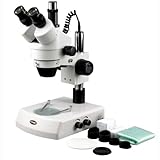
This stereo microscope is the third product I buy from Amscope and I am very satisfied with it. It is very sturdy, the incident light is powerful (it has also a transmitted light) and gives excellent results for a very reasonable price. I use it to look at rock samples. Stereo scopes can't have a very high magnification by definition and in the case of objects with an irregular shape, the more it's magnified, the smaller is the part of the object than can be focused on. That's pure physics, whatever the maker and the price of the microscope.
There are three ways to adjust the magnification and the field (width) of view:
-the zoom with the main objective: from 0.7x to 4.5x
-the Barlow lens: the 0.5 lens allows to work at a longer distance and halves the magnification, the 2.0 lens, which shortens the working distance and doubles the magnification
-the eyepieces: one 10x and one 20x lenses are provided. As on compound ("standard") microscopes (generally equipped with a 10x), they magnify the image given by the objective and optionally the Barlow lens.
-you roughly adjust the working distance by moving the head along the vertical arm and a big knob makes the final precise adjustment.
The pluses of this microscope are:
-a rare 180x magnification (there's only one such model offered by Amscope) by combining the full zoom, the 2.0 Barlow and the 20x eyepiece : 4.5 x 2.0 x 20 = 180 with a field of view of ~1.1 mm
-a very wide field of view thanks to the 2.0 Barlow
This microscope is trinocular i.e. has a third ocular for a camera. Adapter rings are provided for the use of a normal camera. I haven't tried them. I use a digital camera provided by Amscope that I bought with a previous microscope. It's a 5.1 MB camera at a bargain price. There's even a 1.3 MB at a lower price. A USB cable transmits the image to a computer (caution: the camera is only USB 2.0-compatible, not 3.0 but all computers with USB 3.0 have also a 2.0 port). The camera rotates in the ocular tube so one can choose the orientation of the picture (4x3 image as on a standard camera); unfortunately it's a bit difficult to settle the camera in a steady position as the USB cable tends to pull the camera. A ring on the ocular allows to fine focus the camera.
Free software, Toupview, made by Touptek (a Chinese company) accompanies the camera. The older software version had a complicated interface and a very slow response to the focusing/orientation changes, which was very unconvenient, since you had to wait for the image to stabilize before trying a new adjustment. Version 3.7 (free download from touptek.com, in case it's not provided yet by Amscope) is completely new. The interface is very convenient and the response to image changes is almost instantaneous on the screen.
Then comes the hardest part, whatever microscope and camera you use: image adjustment. Standard digital cameras (especially the point and shoot ones) do all the work by themselves: white balance, brightness, color adjustment etc. and usually give you a good compromise. With a dedicated microscope camera you have to do it all by yourself.
First you need to adjust the camera focusing to obtain the best image resolution possible. Even if the scope is correctly tuned for you eyes, the camera must be fine-tuned with the ring on the tube. I recommend to enlarge the screen image at 100-200 % (the full screen image is at 30-60%, depending on the chosen image size) and then use that image to fine-tune the camera.
Secondly you have to adjust the brightness, contrast, color. After some trials and errors, it becomes pretty easy. Roughly, brightness is set through exposure time and color by white balance tuning. You can use the automatic white balance setting if the image has a white area then fine-tune with the temperature and tint sliders. Most of the times, the other manual adjustments, hue, saturation, brightness, contrast and gamma are not necessary and can be left at their default settings. Of course the final image, saved in a variety of formats (jpeg, bmp etc) can be adjusted with an image processing software (e.g. Photoshop of Photoshop Elements). All these features are not so common. For instance I once bought a much more expensive Dino-Lite digital camera, which is almost useless because the accompanying software doesn't allow much image adjustment.
So everything's seems perfect with Amscope microscopes, right?
Not completely. They have to improve the packaging. All standard parts are well protected by a molded polystyrene box. The problem comes with extra parts. When I bought my second microscope from them, with a camera, the software CD had been loosely put in the box, and it arrived broken in several pieces, because of the weight of some parts in contact with it (once more the software is available for free at touptek.com). The documentation booklet is commonly creased for the same reason. This time extra lenses (in their own soft cardboard boxes) had been taped in cavities on the OUTSIDE of the box. One of the small boxes was opened and the lens was loose, but fortunately intact.
I haven't used Amscope's customer service yet, but it seems helpful and effective, after the reviews I read.
The other problem comes with the documentation. It's very scanty, not always specific for a given microscope model and written in broken English. People not used to microscopes can always find useful information on the web, fortunately.
In spite of these limitations that Amscope could easily correct, I recommend this microscope and their microscopes in general. Their prices are very competitive. Don't pay attention to their so-called retail value. All their products are all-year round 50% "discounted". Actually the discount price is about the same as other low-priced brands' such as Motik. Probably the quality of the lens is not comparable to Zeiss', Nikon's etc but the prices are not comparable either! Here for $ 500 (plus $ 200 for a 5 MB camera) you have a very good microscope. For $3,000 you can have your own trinocular 40x-600x polarizing microscope, complete with Bertrand lens etc, while a big brand polarizer as those you find in science labs, costs twice or three times more. What's good with Amscope, compared with other cheap brands sold on the Internet, is that you can find a very comprehensive description of their models on their website. On Amazon's pages, the description is more limited. So I would recommend choosing your product on their website, then use the model series number to search for it on Amazon if, like me, you appreciate the safety of buying through Amazon Marketplace.
Click Here For Most Helpful Customer Reviews >>
Solid construction eyes pieces work great. Good price for a 180X scope.Listed below is the review of the AMSCOPE system I purchase in order to try to shoot underwater video and photos of microscopic plants and animals. I purchased the scope, LED light, and DSLR Adapter. There are a few problems please review.
Issues I faced:
1.) Directions are terrible on how to use the scope. How to assemble it are good.
2.) It took me 2 weeks to figure out how to use the TRINOCULAR port(port on the top) the lever needs to be pulled out(away from the scope) in order to shift the mirror to the TRINOCULAR port. Causing the Left eye port not to work. I thought I would be able to use all three at the same time not the case. I thought at first the unit was broken because I could not figure out what direction to pull the lever(no directions). I had to read on a separate website how most TRINOCULAR scopes work. This being my first.
3.) The AmScope 144-LED Microscope Ring Light with Adapter for Stereo Microscopes is a must in order to see solid objects. The provided Halogen top light is not bright enough. Especially if you plan on taking photos or video with a DSLR. I use the light at full blast and still need additional LED lights when shooting video or or a flash setup when when shooting photos(using the crappy AmScope Canon SLR / D-SLR Camera Adapter for Microscopes). However inorder to mount LED light you need to add one of the screw on 5X or .5X lenses on the bottom.
4.) If the unit is broken be prepared to pay for shipping, insurance, and if returning may even have to pay original shipping. OMAX also available on Amazon has a much better return policy if you need to return an item. You only have to pay for return shipping.
5.) LED lights on the top and bottom would have been better to have since the Halogen lights get extremely hot. My plan is to shoot photos and video of water and I already see a major problem of heat from the bottom Halogen evaporating water or increasing it temp during use. Also the heat causes parts of scope housing the light to produce a slight burning smell of plastic. Perhaps the burning smell will go away with time
6.) MOST IMPORTANT AmScope Canon SLR / D-SLR Camera Adapter for Microscopes. The Microscope Adapter is crap, Don't waste your money purchasing it. It produces very fuzzy, blurry images using a great DSLR such as a CANON T3i or the T2i. Another review of the same adapter for the Nikon can be found here http://www.amazon.com/AmScope-Nikon-Camera-Adapter-Microscopes/dp/B005OZ4BME/ref=sr_1_2?ie=UTF8&qid=1349732830&sr=8-2&keywords=dslr+microscope+adapter
They all say the same thing GOOD LUCK WITH FOCUS. I wished I had read this before I bought the canon version.
PS You will have to do Manual Metering/Shutter speed and Selecting ISO for both photos and video. Not a problem is you understand how to do this for your camera.
Another person having focus issues http://www.amazon.com/AmScope-Canon-Camera-Adapter-Microscopes/product-reviews/B007LBFDB2/ref=cm_cr_dp_qt_hist_three?ie=UTF8&filterBy=addThreeStar&showViewpoints=0

No comments:
Post a Comment