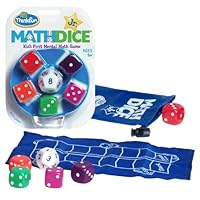


To play this game, you roll the odd sided die to reveal a number, then roll the regular dice to give you a set of numbers with which you have to make the first number. Harder than it seems. You can only use multiplication, addition, division and subtraction to achieve this goal, and only making integers.
The dice are really chunky and colorful, so the kids love them. My youngest loves that she has her own version of her sister's game. It makes her feel grown up! :P
This game comes with a little bag to store the dice. It's small, cheap, and a great way to get kids to practice math with out it being dull! Every parent should buy this game for their kids!
Click Here For Most Helpful Customer Reviews >>
One challenge that we always seem to face when starting a new school year is refreshing the kids' memories. The lazy days of summer always cause them to forget a few keys bits of information. To help ease us back in to the school year, I start a month before having them play fun educational games that reinforce those key skills they will need to start the school year.ThinkFun recently released a new game that is perfect for this and also for use throughout the school year as well to reinforce basic addition and subtraction concepts. It's called Math Dice Jr., and it's very inexpensive. Math Dice Jr. comes complete with a 12-sided Target Die, 5 6-sided Scoring Dice (brightly colored and chunky for smaller hands), a flexible Scoring Track, and a handy dandy pouch to store it all in. It's small and easy to store or take on the go. Gameplay is fairly simple...
Roll the 12-sided Target Die to obtain your target number, then roll the five 6-sided Scoring Dice. Using addition and/or subtraction, combine the Scoring Dice to match the target number, moving one space on the track for every Scoring Die used. The first player to reach the finish line on the scoring track wins!
Math Dice Jr. grows with your child! It not only feature a shorter track for less experienced students, but also allows your child to acquire the target number with simple addition and subtraction using two numbers, or by using a combination of addition and subtraction. For instance, if the player rolls a 7 on the Target Die, and then rolls a 4, 5, 1, 3, and 2 on the five Scoring Die, he/she could use the following problems to reach the number 7 3+4, 5-2, 4+5-2, 5+3-1, 2+1+4, and so on. It can get complicated but only if the child chooses to make it that way. You'd be amazed the combinations they come up with to get those extra spaces or leave less dice remaining for their competitors!
My only complaint is that the game markers used to move along the board are not included, but they do offer printable ones on their website, as well as a printable Scoring Track, too. One of my favorite things about Math Dice Jr. is that all the pieces except for the 12-sided die are easily replaced if lost. The large chunky dice can be replaced by normal game dice, and with the printable options offered on the ThinkFun website you don't have to worry about not being able to play! Find this and more fun educational games at .
**I received this product free of charge for the purpose of this review.
Best Deals for ThinkFun Math Dice Jr.
My 6 1/2 yr old really enjoys this game. It's small so you can take it anywhere and it's educational. The games don't last too long which I greatly appreciate.Honest reviews on ThinkFun Math Dice Jr.
I had an opportunity to finally sit down and play MathDice Jr. this week. My father-in-law is in town, so I roped him and my husband into playing with our five year old.We had tried out the game once before, but I could see her attention wandering, so we had only played the 'short' version.
With all three adults attention focused on her, she did a bit better this time, keeping her attention until the very end.
It is a simple game comprised of a small cloth mat, one target die, five scoring dice, and a little drawstring bag to hold it all.
The one complaint I would have is that I think they should have had some fun tokens to go with it. (Although I just learned from another review that their website has tokens you can print out and use) As it stands right now, you have to go and find some tokens to use on the playing board. That wasn't a big deal though, our five year old was a penny, and then we picked coins according to our age so her grandfather was the quarter.
There is the option for a short game or a long game I think that this is primarily determined by the child's ability to pay attention. My daughter is five, and the game is for six and up, she was getting wiggly and distracted by the end of the long game.
The idea of the game is to throw the target die, a 12-sided die, then throw the five scoring dice, attempting to use them (only once) to add or subtract to the number on the scoring die.
For example, say you had the following scenario..
Target die: 4
Scoring die: 1,5, 3,2,6
You could use them as follows: 5-1=4, 6-2=4
So two combinations. You would then move your token two spaces on the game mat.
You could even use multiplication and division, but MathDice Jr is oriented towards the younger set.
The instructions suggest a more competitive play, in which players shout out "Math Dice" when they see a potential combination, even if it isn't their roll. From the beginning we decided on the cooperative play option mainly because our five year old would be an extreme disadvantage and not be able to make the calculations fast enough.
She's quickly getting there, however, and I could see this game moving at a faster, more exciting pace soon.
What it is doing for her is teaching her how to do basic subtraction and addition on the fly, which is our area of focus currently. So this little game really helps with that.
We also discussed, while playing it, that there should be a bonus for using all of the scoring die in one fell swoop move five paces or something like that.
In any case, we had fun and I can see this game helping my daughter really `get' the concept.
Find helpful customer reviews and review ratings for ThinkFun Math Dice Jr.
I am a first grade teacher and I LOVE MATH DICE! This game is short, flexible and fun! It probes basic math facts and flexibility of thought without kids even realizing it! I own several sets of math dice so that my whole class can play at once this is always a favourite math centre in my classroom. Game options suggested are great we also switched out the game dice for decadice (10 sided) to more directly probe facts of ten in game play. Storage bag makes clean up so easy. Another ThinkFun success!

No comments:
Post a Comment