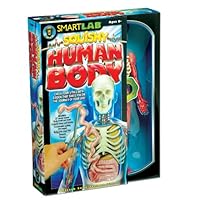


If you don't homeschool, this is still worth having. Use it with your kids to review what they are covering in their lessons. (I believe that's technically called 'afterschooling'!) I don't think it would work well in a classroom, though. Way too small; it needs to be used with maybe 2-3 kids max at a time.
I get it out for every lesson of our human body study. We look at the system we are studying, and it is a tremendous visual aid to understand the physiology.
For example: Today we talked about respiration. The diaphragm can be tricky to explain, so I used this model. With the forceps I pushed the diaphragm piece up and down while making exaggerated sound effects. "What happens to the lungs when I push this up? What about if it pulls down? Where does the air go?" and they were able to see clearly how the diaphragm pulls air in and pushes it out. Never would've gotten that from a textbook.
I also use this model for a Charlotte Mason style of narration. I can take all of the pieces out, and as I put them back in place ask "Hand me the stomach. Which piece is it? What does it do?" The youngest child gets the first shot, and then the older can add what he knows. For review I can hand my son the forceps and ask him to "tell me what happens to food." He can trace the path of an apple through the model and explain what happens in each spot.
Visual aids are a huge asset when learning anything, but especially something that can be hard for a child to visualize, such as the inside of a body. Illustrations in a book are helpful, but this goes several steps beyond. A line sketch of "my digestive system" is good, but too abstract for a young child to really make any meaningful connection with the actual human body. This model is that connecting piece between books and the physical world.
Just a warning: this is fairly delicate. Keep away from the littles. It needs to be kept put away and gotten out for school. Let it get mixed in with other toys and kiss your kidneys goodbye!
If you are doing a human body unit, I also really like How Your Body Works, Grades 1-3 and First Encyclopedia of the Human Body (First Encyclopedias). Good luck!
Click Here For Most Helpful Customer Reviews >>
We bought this toy for our 4 1/2 year old grandson who is always asking questions about how his body works. The smile on his face when he opened this gift was priceless! There are many small parts included, but with adult assistance, he enjoyed taking the body parts out and examining them. The pieces are made of a very soft plastic that almost feels slimy, but isn't. The "touch" added to the mystery of the organs and generated many more questions...a very good learning toy! A chart is included, labeling the body parts for easy identification. The molded outer body is made of two pieces of see-through hard plastic that snaps together easily. (Lay the backside of the body on the table while you replace the body parts and then snap the frontside in place to hold everything together.) A fun, fact-filled book is also included full of great pictures and facts that are fun to read. This toy was perfect for our inquisitive grandson who is able to safely play with small parts. TOY HIGHLY RECOMMENDED!!!SmartLab You Explore It Human Body Model
Best Deals for SmartLab Toys Squishy Human Body
I wanted to love this, but I just couldn't because of the poor construction. The book is a great tool for introducing kids to the human body and it does so in a fun and conversational tone. The diagram of the organs was a big hit with my kids and they spent quite a bit of time matching them up to the poster. The organs themselves fascinate the kids with the squishy, not quite slimy feel. My biggest complaint is with the skull and clear plastic exterior. The skull on our body never clicked when closed, so it would constantly fall off after we attached the exterior pieces. And don't even get me started on trying to close the case around the body. Ours just never seemed to line up right. All of the bones, muscles, and hard plastic pieces are attached with these little (very bendable and breakable) plastic knobs that fit into holes. The bones and muscles don't always fit right and we have a hard time manuvering them. If we move them around too much all of the other various pieces start falling off. I know that you are supposed to "operate" on the body with it laying down, but as soon as we stand the body up the intestines start falling out. I'm careful about not bringing the toy down until I can supervise, but I'm constantly finding organs all over the place, as they easily fall out when it's standing or when we are carrying it. It's such a great idea and a fantastic resource for studying the human body, I just wish the company had spent a little more time and money making the toy durable.Honest reviews on SmartLab Toys Squishy Human Body
This is a model of the human body that can be taken apart and re-assembled. The internal organs are soft to feel more real. It comes with a chart identifying each organ and instructions (mainly for older kids and parents) which show how to put it back together. Paired with a children's anatomy book it's a great lab companion. It's geared to older children (8 and up) but my 4 year old niece loves to take it apart and have Mom & Dad help her put it back together. She is demonstrating an amazing understanding of basic anatomy. Both her parents tell me they now know more about anatomy than ever before. It has turned out to be quite educational for the whole family.Find helpful customer reviews and review ratings for SmartLab Toys Squishy Human Body
I ordered this to teach my children about anatomy. Two days after it arrived, I found my daughters and a friend of theirs playing with it. They actually played with it for a good hour, and then they played with it again the next day for a couple of hours. It is one of their favorite toys now. They don't even realize that it was meant to educate!

No comments:
Post a Comment